Specialty catalog tiles — Amniotic, Biologics, and Conservative Care
The three specialty tiles (Amniotic, Biologics, Conservative Care) still appear in the Inventory Management hub, and receiving still flows through them. What is changing: the three category tables that back these tiles are being retired in favor of a single unified catalog. On demo and production, those legacy tables already hold zero rows — today's specialty products flow through the new catalog under the hood, and the tiles you see are a compatibility surface.
Use this page while the tiles are still visible. When the migration completes, the tiles will be replaced by category filters on the unified Product Catalog and this article will be superseded. Track the unified path here: Manage products in the Product Catalog. Vendor-side context: Vendor Portal Guide.
Understand the three product-category tiles in the Inventory Management hub, what distinguishes each category, and how receiving a shipment through each tile generates UINs in Main Inventory.
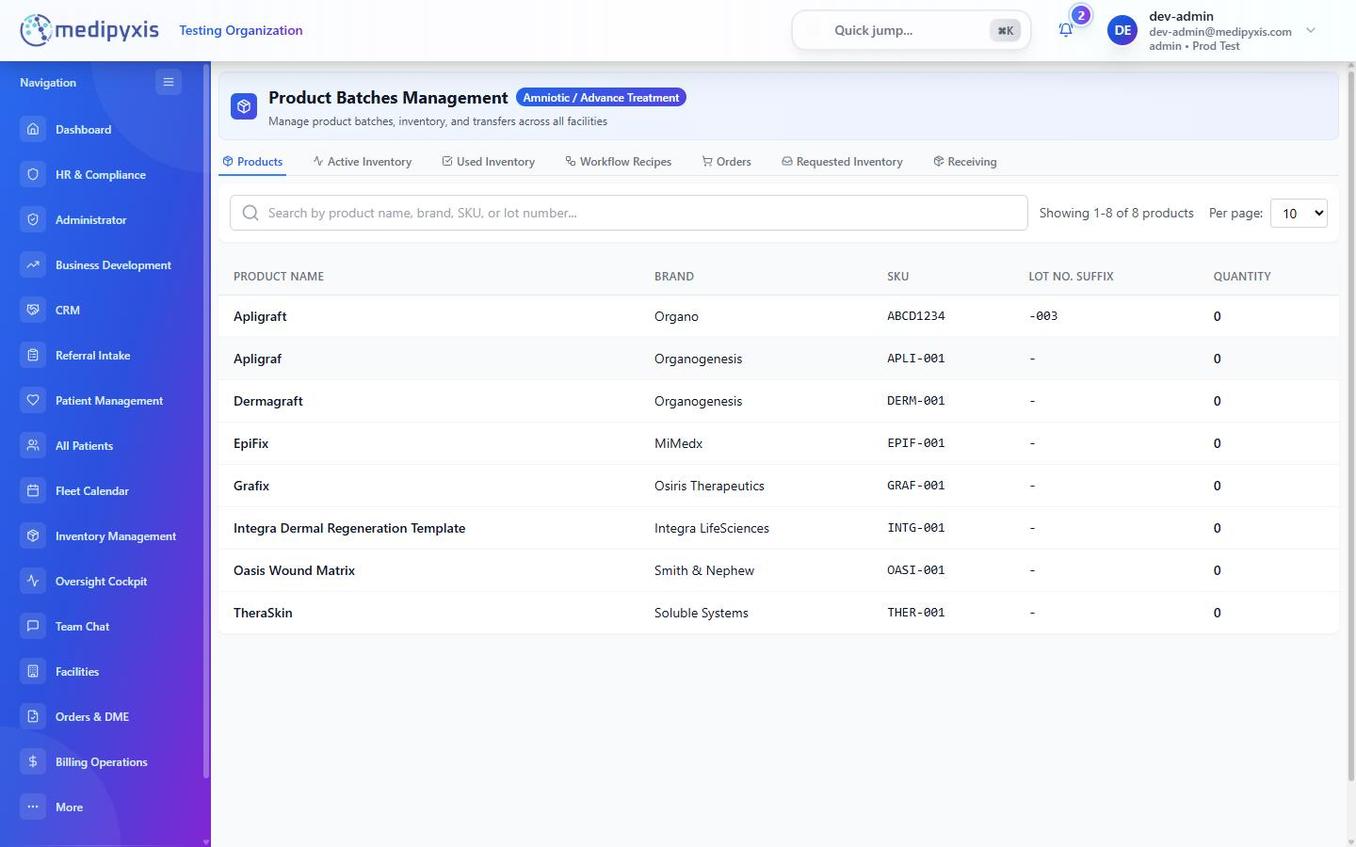
Amniotic / Advance Treatment tile — active units listed with UIN, lot, tissue ID, and expiration date.
Why categories are separated
Medipyxis separates inventory by product class because each has different regulatory, billing, and clinical-documentation requirements. Keeping them in distinct tiles makes it faster to locate the right product during a visit and ensures the system enforces the correct validation rules at receiving time.
This article covers the three graft/supply categories below. Two more categories — PRP (platelet-rich plasma kits) and Ultrasonic Mist (UM) — have their own hub tiles and receive the same way; like conservative care, they do not require IVR prior authorization.
Amniotic / Advance Treatment
Amniotic / Advance Treatment covers amniotic membrane allografts and similarly classified advance-treatment wound products. These products are typically sourced from tissue banks and are subject to tissue-tracking requirements under FDA 21 CFR Part 1271.
What the receiving workflow captures:
| Field | Notes |
|---|---|
| Tissue ID | Donor tissue identifier assigned by the tissue bank. Required for traceability. |
| Lot # | Manufacturer lot number, validated against the product's LOT SUFFIX in the Product Catalog. |
| Expiration Date | Printed on the package label. The system blocks use of expired units at the Visit Wizard. |
| Size | Graft dimensions (e.g., 2×3 cm). |
| HCPCS | Pulled automatically from the Product Catalog entry; editable at receiving if the shipment packing list differs. |
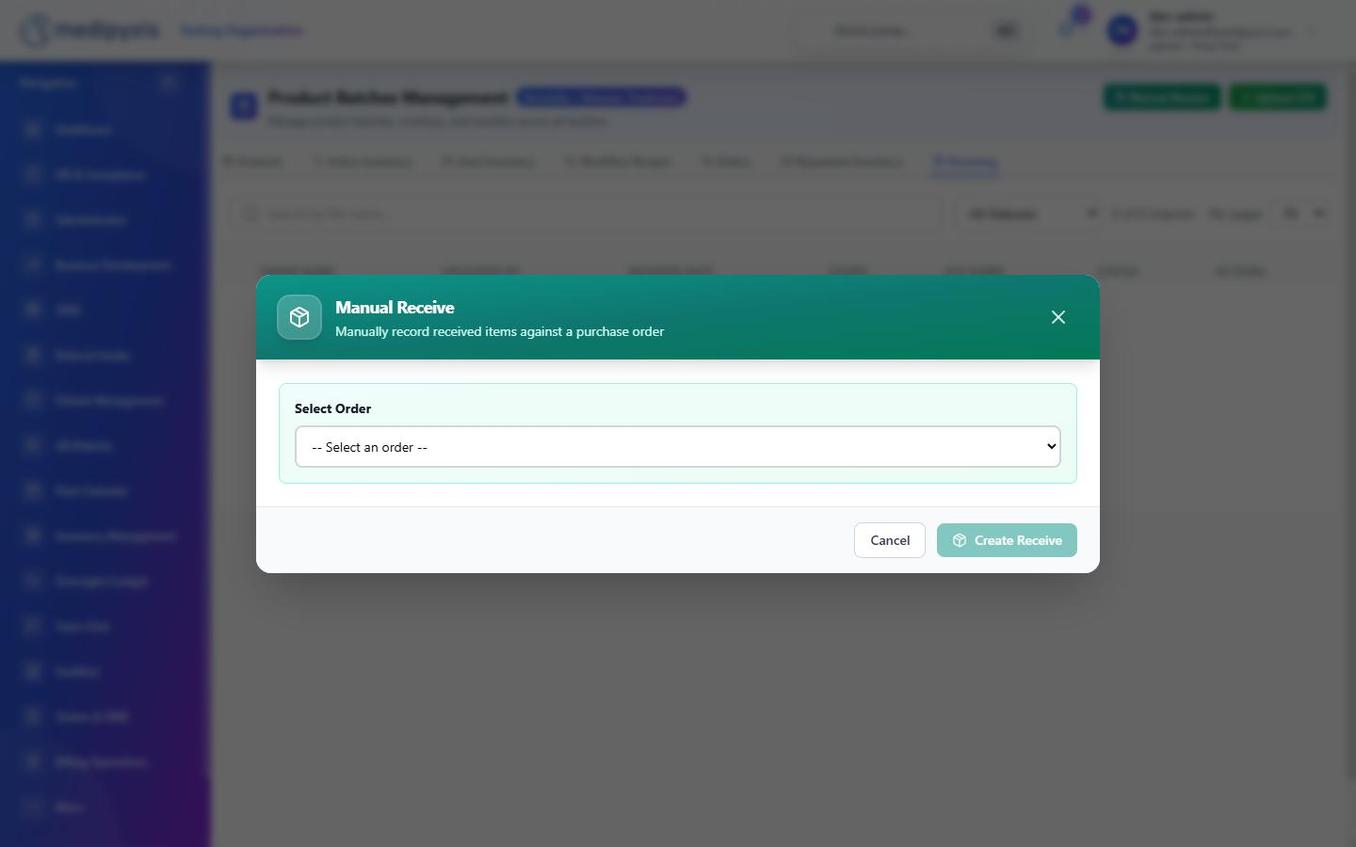
Amniotic receiving form. Each unit entered here generates one UIN in Main Inventory.
Biologics / Matrix
Biologics / Matrix covers extracellular matrix products, collagen-based wound fillers, and other biologic-category grafts. This category has the strictest data-entry requirements because biologic products are billed under HCPCS codes that are audited by Medicare and other payers.
Additional requirements for biologics:
- HCPCS is mandatory. The receiving form will not accept a unit without a valid HCPCS code. Confirm the code against your fee schedule before receiving the shipment.
- Manufacturer lot format is enforced. The lot number entered at receiving must match the pattern defined by the product's LOT SUFFIX in the Product Catalog. If the lot string does not match, the system rejects the entry and displays a format hint. This prevents transcription errors that can cause claim denials.
- Insurance Verification Requests (IVRs) are commonly required for biologic grafts before application. Use IVR Tracking to confirm payer authorization is in place before scheduling the procedure.
Conservative Care Products
Conservative Care Products covers non-graft wound-care supplies: dressings, topical agents, offloading devices, compression wraps, and similar consumables. The type list is broad (foams, alginates, collagen matrices, compression, solutions, and more) and also includes general operational supply types such as Surgical Instrument, PPE, and General Supply. These products generally do not require HCPCS codes, though you may optionally add one if the product is billed separately on a claim.
Key differences from graft categories:
- Tissue ID is not collected — conservative care products are not human-tissue products and have no traceability requirement under 21 CFR Part 1271.
- HCPCS is optional — supply items that are bundled into the visit E/M charge do not need a HCPCS code in inventory.
- PAR-level alerts are more commonly used for conservative care products because they are consumed in high volume. Set a PAR level on frequently used items so replenishment alerts fire before stockouts occur.
How receiving creates UINs
Regardless of category, every unit entered through a receiving form generates exactly one UIN (Unique Inventory Number) in Main Inventory. The UIN is the bridge between the physical item and its clinical and billing records. When a clinician selects a product in the Procedures & Supplies section of the Visit Wizard, they scan or enter the UIN to record which specific physical unit was applied to the patient.
Related
Auto-rendered from related: in frontmatter.